



Evidence-first, workflow-ready: How Harrison.ai is meeting European radiology where it is.
From Helsinki to Rome, European radiology teams are adopting Harrison.ai’s imaging AI to address one of the specialty’s most pressing structural challenges — and the map of active sites keeps expanding.
The pressure facing European radiology
European radiology faces a structural supply-demand imbalance that available data suggests will persist without deliberate intervention. Imaging volumes across the continent are rising steadily, driven by
- demographic ageing
- the expansion of organised cancer screening programmes
- and growing clinical reliance on cross-sectional modalities
while radiologist supply has not kept pace. A 2024 workforce survey published in European Radiology projected a shortfall of over 30,000 radiologists across Europe by 2030, a gap that incremental training expansion alone is unlikely to close. ¹
The European Society of Radiology has documented these pressures across successive workforce reports, noting that radiologist attrition and an ageing specialist population compound the pipeline problem beyond what recruitment alone can address. ²
The clinical consequences are measurable: median report turnaround times have lengthened in high-volume centres, overnight and weekend reporting backlogs have grown, and per-radiologist workload has increased materially across many health systems. ³
For hospital procurement teams and clinical leads, the strategic question has shifted. Evidence from multicentre trials and real-world deployment studies including work published in The Lancet Digital Health and Radiology has moved AI-assisted imaging analysis from proof-of-concept into the domain of validated clinical tools.⁴˒⁵ The question is no longer whether AI has a role in routine radiology practice. It is which systems carry sufficient clinical evidence, regulatory clearance, and integration maturity to be deployed responsibly at scale.
That distinction matters in a European context. EU MDR requirements set a high bar for regulated AI medical devices. Clinicians and procurement teams rightly scrutinise the evidence base behind any tool they integrate into reporting workflows. Not all AI is equal and European providers increasingly know it.
Where Harrison.ai fits in
Harrison.ai was built from the ground up to meet clinical standards, not to approximate them. Its AI is developed and validated through a rigorous evidence-driven methodology, peer-reviewed research, independent clinical validation, and continuous real-world performance monitoring and is designed to support radiologists rather than replace their judgement.
Today, Harrison.ai’s clinical AI is in active use at radiology providers across a number of European countries Finland, the Netherlands, Denmark, Belgium, Germany, Switzerland and Italy, spanning large university hospitals, regional hospital groups and private diagnostic networks. Behind these deployments sits a dedicated European team and EU-based operations, with local expertise to support clinical implementation and ongoing customer relationships in-region.
Built for the European regulatory environment
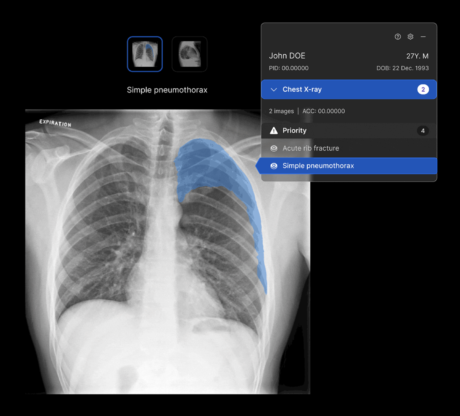
Harrison.ai’s CXR (chest X-ray) and CTB (CT Brain) products anchor most European deployments, with CT Chest (CTC) now joining the mix at select sites. Both flagship products carry EU MDR Class IIb certification, the same classification applied to high-risk medical devices providing European providers with the regulatory confidence required to incorporate AI into routine clinical workflows rather than treating it as an adjunct or experimental tool.
This regulatory grounding is not incidental. EU MDR Class IIb certification demands robust clinical evidence, post-market surveillance, and quality management systems that meet the expectations of European notified bodies. It is precisely the standard that serious clinical AI must meet — and it reflects Harrison.ai’s founding commitment to building AI that can be held to the same rigour as any other clinical tool.

Across the European footprint
a range of institutions have moved from evaluation to active clinical use:
- Kantonsspital Baden (Switzerland), one of Switzerland’s leading hospitals, deploying Harrison’s CXR and CTB to support its radiology team.
- AOU Sant’Andrea (Italy), a major university hospital in Rome, has adopted Harrison.ai CXR.
- HUS – Helsinki University Hospital (Finland): Finland’s largest academic medical centre, uses Harrison.ai CXR and CTB.
- Radboud UMC (Netherlands), a leading university medical centre in Nijmegen, uses Harrison.ai CXR and CTB.
- BG Klinikum Duisburg (Germany), a specialist trauma and acute-care centre, uses Harrison.ai CTB.
Why European providers are choosing Harrison.ai
The adoption pattern across Europe reflects a few consistent themes that emerge in conversations with clinical and operational leads at partner sites.
- Clinical and evidence-driven
Harrison.ai’s AI is developed through peer-reviewed research and rigorous clinical validation — not optimised purely for commercial deployment. Radiologists engaging with the evidence base find the approach transparent and consistent with how they evaluate any clinical tool.
- Clinical breadth where it matters most
CXR and CTB address two of the highest-volume, highest-acuity imaging streams in any European department. CTC extends coverage further. Together, they target the modalities where AI assistance has the greatest immediate impact on throughput and clinical risk.
- Workflow-native integration
The AI integrates into existing RIS/PACS reporting environments rather than imposing a parallel system. For already-stretched radiology teams, this is not a minor point; it is often the difference between adoption and shelf-ware.
- Regulated for the European market
EU MDR Class IIb certification provides the regulatory foundation that procurement, legal and clinical governance teams require before deploying AI in routine care. Harrison.ai met that bar, it was not retrofitted to it.
- Proven at global scale
Harrison.ai’s solutions are live across more than 1,000 sites worldwide and have supported nearly seven million patient cases. European providers benefit from a platform that has been stress-tested across diverse health systems, patient populations, and imaging environments.
Explore how AI could drive clinical and operational benefits for your organisation.
The map keeps growing
Europe’s radiology challenge is structural, not cyclical. Workforce supply will not catch up with imaging demand through training alone, and waiting list targets will not be met without systemic change. Clinical AI, held to the same evidential standards as any other intervention, is increasingly part of how serious radiology providers are responding.
Harrison.ai’s European footprint has grown from a single university hospital to a network spanning seven countries, and that momentum reflects a growing clinical consensus: the question is no longer whether to adopt AI, but which AI deserves the trust that clinical practice demands. If your department or organisation is working through that question, we would welcome the conversation.
Explore how Harrison.ai can support your radiology practise – Book a meeting now
References
- Sabel BO, et al. “Radiologist workforce in Europe: current status and future challenges.” European Radiology, 2024.
- European Society of Radiology. ESR iGuide and Workforce Reports, 2023–2024.
- Brady AP, et al. “Radiology in the era of value-based healthcare.” Insights into Imaging, 2023.
- Larson DB, et al. “Performance of a deep-learning neural network model in assessing skeletal maturity on pediatric hand radiographs.” Radiology, 2023.
- McKinney SM, et al. “International evaluation of an AI system for breast cancer screening.” The Lancet Digital Health, 2020.
This device is not intended to provide direct diagnosis. Harrison.ai chest X-ray (CXR) is the marketing name for Annalise Enterprise and Annalise Container. Check current regulatory status with a Harrison.ai employee (info@Harrison.ai).
 2797
2797

See it for yourself
Explore how AI could drive clinical and operational benefits for your organisation.