



How a US Health System Achieved $100K NTAP Reimbursement in Four Months
When a hospital adopts clinical AI, the first question leadership asks is rarely “Does it work?”; more often, it’s “How do we justify the investment?”
A leading nonprofit academic health system answered that question in a way few have by turning an AI-assisted triage tool to flag the time-critical finding of obstructive hydrocephalus on head CT into a genuine, recurring source of reimbursement.
Obstructive hydrocephalus (OHCP) is a buildup of cerebrospinal fluid that cannot drain, causing pressure inside the skull. Identification on non-contrast CT (NCCT) head triggers rapid neurosurgical intervention; missed or delayed, it can lead to herniation and death.1
OHCP is comparatively low-frequency, so it competes for attention on busy worklists, exactly where an AI triage and notification adds value. For a network reading thousands of NCCT head studies a year, moving these studies to the top of the worklist, quickly and consistently, is both a patient-safety priority and an operational one.
The customer is an integrated, nonprofit academic health system serving communities across the United States. Spanning six hospitals, more than 1,000 acute-care beds, and over 250 outpatient sites, it runs on Epic EHR and reads roughly 23,000 CT brain studies each year.
The network chose Harrison.ai Comprehensive Care, which analyzes every NCCT head and raises both passive and active alerts when OHCP is suspected. The device received FDA 510(k) clearance in September 2023 and holds Breakthrough Device designation, making it the first AI OHCP triage solution.
That Breakthrough status proved to matter beyond clinical credibility. It’s the same designation that qualified the device for Medicare’s New Technology Add-on Payment (NTAP), so the clinical capability arrived with a reimbursement pathway already attached. For a health system that had made ROI a condition of adoption, that was the deciding factor: NTAP tied a defined revenue line directly to the deployment and integration.
Once the solution was live and the workflow was in place, the reimbursement began to accrue. One network site alone captured over $12,000 across 50 confirmed inpatient encounters; each patient who qualified received the full $241.39 reimbursement.
Network-wide, the total passed $100,000 in about four months, all routed automatically through Epic EHR. Because every dollar is an add-on to the DRG, it’s closing the gap on reimbursement imaging the network was already doing, with near-zero added effort for radiologists. (8)
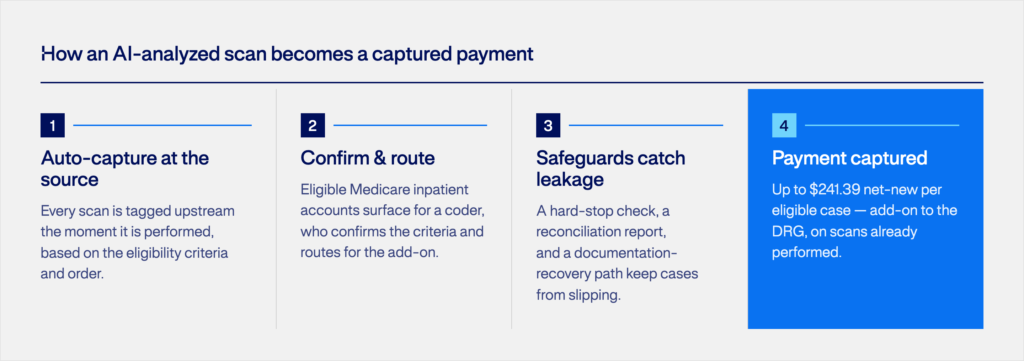
The network treated NTAP as an operating challenge, not a billing footnote, and stood up a cross-functional working group to solve it – pulling together radiology informatics, IT and PMO, HIM coding, revenue cycle and compliance, and the billing office. What they built is an Epic-native pipeline that carries a case from the scan to payment largely on its own, with a safeguard at each step, so eligible cases do not quietly slip away.
The result is a repeatable machine (Figure 1): cases captured automatically, based on eligibility criteria and order, confirmed by a coder, and protected by checks that make it hard for revenue to leak, up to $241.39 of net-new payment per eligible case, on scans performed. The next steps are closing out the manual gap to help streamline the process.
Medicare’s NTAP exists to solve a timing problem. When a genuinely innovative technology arrives, its cost isn’t yet reflected in the DRG – the fixed amount a hospital is paid for a given admission. NTAP closes that gap, paying an add-on of up to 65% of the technology cost on top of the standard DRG. It’s temporary (up to three years), and for Breakthrough-designated devices the qualification path is streamlined.
For Harrison.ai OHCP triage, that translates to:
- Up to $241.39 per eligible case — 65% of the technology’s average cost.
- A coverage window running through September 30, 2027.
- Eligibility, case by case: a Medicare patient, admitted, whose head CT is analyzed by the device where OHCP is in the differential, and whose DRG under-reimburses the cost of their care.
- The cap applies per case regardless of volume; what’s actually paid tracks the cost of each patient’s stay, up to the ceiling.
The reimbursement enabled the health system to achieve the complete value of AI. Faster triage of critical findings helps care teams reach the right patients sooner, reducing delays and complications that drive downstream costs. Prioritizing urgent studies eases pressure on radiology as imaging volumes continue to climb. And because the whole workflow lives inside Epic, the model does not get stuck at one site. It repeats across every eligible hospital in the network, strengthening the case for clinical AI each time.
What this health system has shown is simple but powerful: pair an AI triage tool for a time-critical finding with a deliberate reimbursement workflow, and the technology can pay for itself on imaging already being performed, captured reliably rather than by luck. AI adoption becomes far easier to champion when clinical value and financial value point in the same direction, and this network’s Epic-native playbook is a template other health systems can follow to turn a breakthrough device into reimbursed value.
Disclaimer: This case study has been anonymized at the customer’s request; the health system is not named. Harrison.ai Radiology solutions were previously marketed as Annalise.ai solutions. Reimbursement figures reflect amounts realized over the stated period and are not a projection of future results.
References
- Hydrocephalus. StatPearls, National Library of Medicine (NIH). https://www.ncbi.nlm.nih.gov/books/NBK560875/
- GibbsWN et al. Imaging of Applied Radiology. https://appliedradiology.com/articles/imaging-of-hydrocephalus
- FDA 510(k) Premarket Notification K231094, “Annalise Enterprise CTB Triage – OH.” U.S. Food & Drug Administration. https://www.accessdata.fda.gov/cdrh_docs/pdf23/K231094.pdf
- “Annalise.ai Receives FDA Clearance and Breakthrough Device Designation.” Harrison.ai, 13 September 2023. https://harrison.ai/news/annalise-ai-receives-fda-clearance-and-breakthrough-device-designation/
- “New Medical Services and New Technologies (New Technology Add-on Payment).” Centers for Medicare & Medicaid Services (CMS). https://www.cms.gov/medicare/payment/prospective-payment-systems/acute-inpatient-pps/new-medical-services-and-new-technologies
- “Navigating the New Technology Add-on Payment (NTAP) Process.” McDermott+ Consulting. https://www.mcdermottplus.com/resource/navigating-the-new-technology-add-on-payment-ntap-process/
- “CMS approves head NCCT AI product for new technology add-on payments” (FY2025 IPPS final rule; NTAP of $241.39 per eligible case).AuntMinnie, 2024. https://www.auntminnie.com/imaging-informatics/artificial-intelligence/article/15682460/annaliseai-cms-approves-head-ncct-ai-product-for-new-technology-addon-payments
- Harrison.ai internal deployment and reimbursement data; customer financial records (2026). Figures reflect amounts realized over the stated period and are not a projection of future results.