

Harrison.ai releases Harrison.Rad 1.5, a radiology foundation model that can draft reports from images, priors and clinical context
The new model passes a mock examination of 25 X-rays in a similar style to the FRCR 2B Short Case where no other evaluated AI model passes, extending the lead Harrison.ai set with Rad 1.
BOSTON, JUNE 9th 2026 — Global radiology leader Harrison.ai today launched Harrison.Rad 1.5, a radiology foundation model that can reason over images and clinical context, including priors, to produce a high-quality draft report for review by a radiologist. Available immediately for research at chat.harrison.ai and API access on request, Harrison.Rad 1.5 is the highest scoring AI model to pass a mock examination of 25 X-rays in a similar style to the FRCR 2B Short Case exam, while every radiology-specific and frontier model evaluated falls short.
Harrison.Rad 1.5 advances the program Harrison.ai began with Harrison.Rad 1 in 2024, which established the company as a leader in domain-specific foundation models for radiology. The new release widens that lead: stronger reasoning across complex, multi-finding studies, sharper anatomical localisation, broader coverage across body parts, and, most significantly, the ability to read a current study against a prior and describe what has changed in natural radiologist prose rather than a checklist of flagged findings.
That draft-reporting capability is the center of gravity for the release. Rather than detecting findings in isolation, Harrison.Rad 1.5 can interpret a study in light of the clinical question being asked and the patient’s history, then it can draft a report intended to give the radiologist something precise to work from.
“You can’t skip steps in radiology AI. Before an AI model can help generate a report, it has to be excellent at detection, and that’s what we’ve been tirelessly working on over the past 8 years. Our regulatory-approved detection products for chest X-rays, Brain CTs and Chest CTs are being used every day, impacting more than a million patients per month. Harrison.Rad 1.5 is the next step towards bringing meaningful innovation forward that will impact the future practice of radiology,” said Dr Aengus Tran, CEO and co-founder of Harrison.ai. “Reporting is where radiologists spend their time. The future is where our Harrison.Rad foundation model drafts a high-quality report for the radiologist to review and sign off, without replacing their judgement.”
To measure that progress, Harrison.ai evaluated Harrison.Rad 1.5 and other frontier models on an exam human radiologists take, using externally sourced data not seen during training. On a mock examination of 25 X-rays in a similar style to the FRCR 2B Short Case, Harrison.Rad 1.5 Agent achieved a median score of 86.5, above the mean cut-off of 73.2 needed to pass. No other evaluated models passed these simulations.
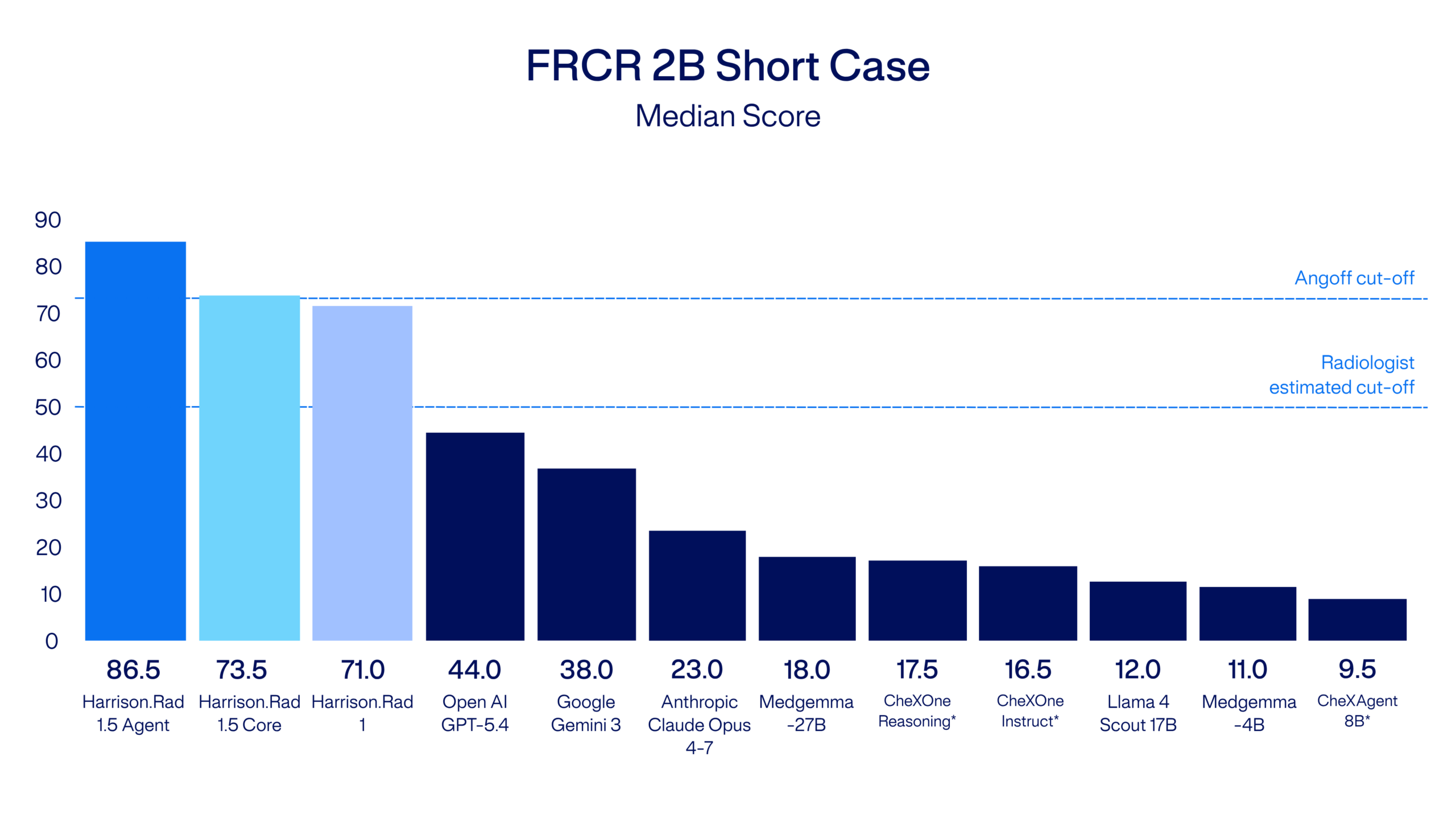
Caption: Graph showing AI models’ performance on the mock FRCR exam
Dr. Jarrel Seah, Neuroradiologist and Chief Medical and AI Officer at Harrison.ai said: “It was trained on 6 million diagnostic studies and 18 million clinically crafted conversations. The gains show up most clearly on the hardest cases: studies with priors, post-procedural work, and findings outside the classical reporting ontology. Eighteen months on from Harrison.Rad 1, the gap between our purpose-built model and the world’s leading general-purpose models hasn’t closed, it’s widened. Clinical radiology demands a level of specificity that only comes from purpose-built training.”
The improvements rest on larger training data and better methodologies. Harrison.Rad 1.5 was trained on approximately 6 million diagnostic imaging studies, a 33% increase over Harrison.Rad 1, using new techniques designed for precision and differentiation, and an architecture that lets the model adapt how it interprets an image to the clinical question being asked. All of it ran on a new NVIDIA B200 GPU cluster.
“There are three things I’m most proud of in this release: data quality, clinical alignment, and a fundamental change in how the model interprets images,” said Suneeta Mall, Head of AI Engineering at Harrison.ai. “We invested heavily in the signal the model learns from: cleaner data, clinically crafted hard negatives that force the model to distinguish between visually similar images, and preserving native aspect ratios so the model sees images the way a radiologist does. Training at this scale on the B200 cluster gave us the headroom to be far more ambitious with our methods.”
Harrison.Rad.1.5 is intended for research, benchmarking, and evaluation purposes only. Harrison.ai is actively pursuing regulatory clearance, approval, or certification for products built on these foundational models in major markets including the US and EU countries.